As early as the second half of the nineteenth century Greek historians sought to furnish Greece with a national history worthy of a modern European state. The historian and folklorist Spyridon Zambelios (c. 1813-1881) was the first Greek scholar officially to speak of the national character of the Greek people, a character evident throughout its three-thousand-year long history.
His references to Greek national consciousness, his emotive invocations of a throbbing national heart he could detect in Byzantium as well as in classical antiquity, echo the rhetoric of German Romantics such as the philosopher Johann Georg Hamann and his disciple Johann Gottfried von Herder, as well as the eighteenth-century Neapolitan critic of the Enlightenment Giambattista Vico, who may have been an inspiration to them. Zambelios assumed the task of constructing a coherent time-line for Greek history, capable of withstanding external (i.e. European) scrutiny. His effervescent rhetoric builds on Romantic rapture, though tacitly claiming this as a purely Greek trait.

Konstantinos Paparrigopoulos, Professor of History at the University of Athens, in a remarkable effort to hellenize Greek history, produced a new synthesis, uniting ancient and medieval (Byzantine) Greece with the present. In his
History of the Hellenic Nation, which appeared in many editions and revisions in the period 1860-1876, Paparrigopoulos constructed a tripartite ‘national-time’ scheme for modern Greece as a European nation-state.
Thus, Hellenism became the protagonist in the continuum of the Greek narrative; what for the modern historian could (and would) be seen as a revival – following a murky and inglorious medieval intermission – had to be shown in the Greek nationalist reading to be a survival, even if some of the interim stages had to be left to one’s imagination.

The sentiment underlying this, and many such historiographical endeavours, was an ambivalence towards the West – contempt for its intellectual inferiority and its many shortcomings, as well as an intense anxiety to be accepted, on equal terms, in its circles. Greek folk studies, initiated in the 1880s by Nikolaos Politis, who strongly believed that local customs and traditions preserved the essence of Hellenism, also benefited from an inherent anti-Western tone: a frank return to tradition, Politis was arguing in 1883, would save Greece from losing its soul to the seductive influences of the West.
These fiercely conflicting views marked most of the twentieth century, affecting readings of the Greek (classical) past and (modern) present.

In 1903 the Greek poet and essayist
Periklis Giannopoulos (1869-1910) published his
Greek Line and Colour, urging his compatriots to reunite with the spirit of ancestral Hellenism and overthrow the ‘tyranny of the West’ through a thorough reappraisal of the national Greek values. According to Giannopoulos, these values had been invested in the Greeks by their own earth, the Greek land that created its people ‘in her own image and likeness’.
Inspired by Darwinian and other evolutionist theories of culture developed in Europe, mostly Germany, this vein of determinist reasoning has had a lasting effect on Greek perceptions of history, geography and race. Biological idiosyncrasies and climatic conditions were (and often still are) seen as determining factors for culture, and Greek art – understood as a reflection of the contours and colours of the Greek landscape – was perceived as an expression of this interaction between man and his land.

The chief idea expressed by Giannopoulos in his polemical essay is that the Greek soil is the cradle of Greek aesthetics, and that Greek art was the product of the dialogue between the Greeks and their own environment. The nub of his critique was his fierce anti-Occidentalism, a sentiment he shared with many of the young thinkers and activists of his day. Greek cultural identity had to be regained, as a bulwark against the deceptive forces of the West and the complacency of the East, which had left a deep imprint on Greek soil, with an Ottoman occupation that had lasted four hundred years too long. Giannopoulos and his fellow radicals could not hide their frustration at the westernization of their homeland: in the process of becoming a bona fide Western state, Greece was abandoning its Hellenic destiny.
Following a humiliating defeat in the war against Turkey in 1897 and the Catastrophe that followed the invasion of Turkish Asia Minor by Greek troops in 1921-1922, the Greeks finally realized that their nation was to remain confined within the territory held by their state. Thus, the nationalist Megali Idea (‘Great Idea’), a highly romanticized claim for a ‘Greater Greece’, a sovereign state that would stretch over every territory inhabited by Hellenes, was finally abandoned more than sixty years after its conception.

Disenchanted by the unceremonious end of the Greek imperialist dream, a younger generation of intellectuals who emerged in the country’s cultural life around 1930 (who became known as the ‘generation of the thirties’), displayed a markedly more introvert attitude. Their influence on Greek culture was strongly felt for the decades to come and many aspects of their legacy remain evident to the present day. These active essayists, critics, novelists and poets devoted their energy to a new central concept for Greek identity, what they called hellenikoteta (‘Greekness’) or Hellenicity.
Hellenicity referred to the intrinsic qualities of the Greek psyche which had survived, often undetected, through antiquity and Byzantium, to the present day. Thanks to their middle- or upper-middle class upbringing and studies abroad (in Western Europe, mostly Germany), the members of the generation of the thirties understood well the challenges modernity – modernization even – posed for their country. While striving to reunite modern Greece with its long-lost Hellenic psyche, they endeavoured to promote Greek culture in the West, as a reminder to the European Occident of its cultural debt to the Greek Orient.


On the surface at least, one might think that their attempts were generally successful: two of the group’s most prominent poets, Seferis and Elytis, became Greece’s only Nobel-laureate poets to date, in 1963 and 1979 respectively. Evidently, their Greekness had touched some European chords.

Intriguingly, Greek intellectuals in the thirties seemed to believe that the ‘new humanism’ they were after could be further inspired by the environmental-determinist views promoted by Giannopoulos at the beginning of the century, views which they duly revived, along with – to a certain extent – his reckless rhetoric which remains popular to the present day. A new sort of hellenocentric radicalism made it obligatory for Greek intellectuals or artists to declare their fascination with the landscapes of Attica, the colours of Greek nature and certainly the Aegean and its islands: this becomes the cradle and residence of Hellenism, to which all the characteristics which shape Hellenicity are to be credited. Thus, the Greek quest for a national identity veered towards aesthetics.
The Metaxas dictatorship in 1936 pushed for a further ideological swing. Metaxas wrested Hellenicity from the hands of his liberal or communist rivals (effectively silencing the latter through exile, imprisonment, or worse). From then on, the Greek Left and the Greek Right turned Hellenicity into a site of conflict, in a landscape of ideological intolerance, which showed no signs of subsiding in the bitter post-civil war years of the fifties and the sixties. Attacked from the right, liberal intellectuals now had to prove their patriotism by elaborating on stereotypes about the Greek soul and the eternal spirit of Greek culture. Meanwhile, many communist intellectuals, originally indifferent, if not positively hostile to the notion of Hellenicity, were finally forced to subscribe to it, lest they be accused of ‘cosmopolitanism’. Though apparently centred on the past, the issue under debate was present-day relations with Europe; for the liberals ‘Greekness’ could be perceived within a European framework, and was thus a bona fide ingredient of modernity. For Greek conservatives, on the other hand, modernity was certainly anti-Hellenic. Inevitably, the rift caused was vast, and its impact is still felt in present-day Greece, not to mention the frequent invocation of nationalist rhetoric (with the appropriate emphasis on the amalgam of Greek heritage and Orthodox tradition) by many a self-appointed spokesman of the so-called Greek radical Right. Hellenocentric history, sterile archaeolatry, and frustrated anti-Western rhetoric remain, to the present day, the vital elements of the intellectual ancestry of every conservative in the country, with the Metaxas regime still providing both the ideological stimulant and the visual back-up for such expressions of patriotism.
It was in this cultural and political environment that Greek history, viewed through art, came to be seen as a single entity. Greek Modernism, represented by the intellectuals of the generation of the thirties or internationally renowned personalities, promoted ideas on the singular essence of Hellenic art – Prehistoric to Byzantine.
Strengthened by the 1936 coup, the Greek Right used Hellenicity as a patriotic index of sorts, in order to silence its political opponents, and to restrict intellectual contacts abroad. This was an anti-modern and anti-Western, xenophobic reading of Hellenicity, susceptible to state control.
Konstantinos Tsatsos, a self-styled ‘Platonic’ philosopher and politician with some presence in Greek politics before and after the 1967 dictatorship, produced numerous essays in which he is concerned with Hellenic creativity. He despises any sign of Modernism in literature and art ‘because it excludes Hellenicity’. For him, Hellenicity is a prerequisite of authenticity: ‘I don’t need authenticity in order to have a Hellenic work; I want Hellenicity so that the work may be authentic’.
As it happened, Tsatsos became (reluctantly?) the protagonist in a farcical episode in Greek cultural politics, involving the Liberal Left, the Right, and control over Hellenic antiquity and tradition:
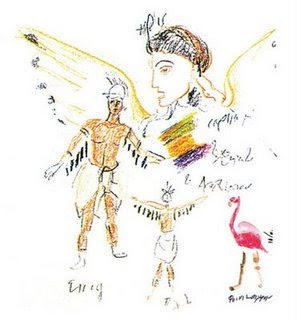
On 29 August 1959, a performance of Aristophanes’ The Birds by the Art Theatre Company at the newly restored open-air Herod Atticus Theatre was interrupted by angry spectators, when a Byzantine psalm was interpolated in the play’s sacrifice scene. The show had been directed by Karolos Koun, Greece’s leading avant-garde director at the time, who attempted, with considerable success, to link his work with folk tradition and antiquity – very much in the fashion of the generation of thirties. His collaborators in The Birds included the painter Yannis Tsarouchis and the composer Manos Hadjidakis, all three united by a common vision of antiquity, folklore and contemporary culture. Tsatsos, then Minister of the Interior for a radical right-wing government, personally ordered that the three remaining performances be cancelled, on the grounds that the performance ‘distorted the meaning of the classical text [and] insulted the religious sentiment of the people’. Clearly, Hellenicity was too important to be left in the hands of irresponsible intellectuals.

1959 was (yet another) crucial year in Greek politics, when the right-wing National Radical Union party, under the leadership of Konstantinos Karamanlis, was in government. However, in the elections of the previous year, the United Democratic Left had emerged as the official opposition and was severely attacking the government on its handling of the Cyprus issue and the Zurich talks early that year. As Richard Clogg puts it: ‘Karamanlis came under fire from the opposition for betraying the cause of Hellenism in the interests of NATO and the Americans’. (Below, Karamanlis and Tsatsos from a cartoon published following the Birds scandal; Tsatsos is accompanied by a chicken - in Greek ornitha - which became his not-so-affectionate nickname after he banned the performance of The Birds - in modern Greek ornithes.)

Evidently, Tsatsos and the Greek Right had their own views on Hellenism and the way its interests should be defended, at least domestically. Following the termination of the seven-year military dictatorship in 1974, Karamanlis was elected Prime Minister and Tsatsos President of the Republic. While no overt references to their ideas were included in the 2004 Olympic Ceremony, Hadjidakis and Tsarouchis were right there in the forefront of things, the former thanks to the use of his dreamy music, and the latter as a not-so-distant inspiration behind many of the costumes or the staged scenes (particularly the navy bands parading by the seafront). The spirit of the generation of the thirties lives on, one might assume, though only in its most conservative, intellectually sterile mutations, calling for repetitive invocations of the past as a mechanistic measure against the discontents of the present.

As Alexis Dimaras assessed in 1983, we ended up propagating an ‘official Hellenicity’, enforced by the state educational system through a regime of fear: fear that, through a crack in the system, ‘the real face of modern Greece might be revealed’ or that the character of this official Hellenicity may get tampered with.
From my introduction to A Singular Antiquity.




 a plastic sunrise on the acropolis