6 Φεβ 2009

Περί Ιστορίας

Διάβαζα στη Lifo τη συνέντευξη της Μαριέττας Γιαννάκου ("Πολιτικός, ψυχίατρος. Γεννήθηκε στο Γεράκι Λακωνίας, ζει στα Κάτω Πατήσια. Διάβασε Σαρτρ στην έκτη δημοτικού") και δεν μπορώ να πω ότι περίμενα να διαβάσω κάτι ουσιώδες - ούτε η περίσταση ήταν κατάλληλη ούτε θα περίμενε κανείς καίριες παρεμβάσεις σε αυτό το πλαίσιο ("ήμουν άριστη μαθήτρια, είχα 20 σε όλα τα μαθήματα").

Μου έκανε όμως εντύπωση η εισαγωγική της δήλωση: "Το χωριό μου, το Γεράκι (Δήμος Γερονθρών), έχει χιλιάδες χρόνια ιστορία, από παλαιολιθικά ευρήματα μέχρι βυζαντινά, 30 σωζώμενες (sic) εκκλησίες από τις 300, κάστρο σημαντικό. Είχα πάντα επίγνωση της ιστορικότητας του τόπου όπου μεγάλωνα, ενός δήμου αρχαίου." Όσο γραφικός και να ακούγεται αυτός ο αυτοαναφορικός τοπικισμός ("το δικό μου το χωριό είχε κάποτε 300 εκκλησίες") δεν μπορεί παρά να επισημάνει κανείς την χοντροκομμένη άποψη περί ατομικής και εθνικής Ιστορίας που προβάλλει εδώ η Γιαννάκου. Το μήκος του χρόνου ("χιλιάδες χρόνια") και ο όγκος των αρχαιολογικών ευρημάτων ("από παλαιολιθικά [...] μέχρι βυζαντινά") θεωρούνται, ως συνήθως, αρκετά για να τεκμηριώσουν την αξία, αυτό που η Γιαννάκου αποκαλεί "ιστορικότητα". Ίσως υπερβολικά κοινότοπη για να σχολιαστεί σοβαρά, η φράση αυτή εμπεριέχει την τρέχουσα ελληνική αντίληψη περί ιστορίας: ως αρχαιολογίας της ελληνικής γης. Όπου το έθνος γίνεται ένα με τον τόπο, ώστε να προεκταθεί και πέραν των ορίων του - η Γιαννάκου φαίνεται να συμπεριλαμβάνει την παλαιολιθική περίοδο στην προσωπική της γενεαλογία.

Η συνεντευξιαζόμενη φαίνεται να έχει υπόψη της το λήμμα "Γεράκι Λακωνίας" της περιβόητης ΒΙΚΙΠΑίΔΕΙΑΣ, όπου διαβάζουμε τα εξίσου ενθουσιώδη: "Το Γεράκι, κωμόπολη της Λακωνίας, βρίσκεται 39 χιλιόμετρα νοτιοανατολικά της Σπάρτης και σε υψόμετρο 300 μέτρων από την θάλασσα και είναι ίσως από τις ελάχιστες περιοχές της Ελλάδος, που παρουσιάζουν ιστορικό βίο σχεδόν 2.500 χρόνων, χωρίς διακοπή. [...] Οι αρχαιολογικές ανασκαφές, έχουν φέρει στο φως αρκετά αντικείμενα της προϊστορικής εποχής. Επίσης αγγεία της Μυκηναϊκής και γλυπτά της Δωρικής (sic) περιόδου, μερικά από τα οποία είναι εκτεθειμένα στο Μουσείο της Σπάρτης. Τέλος, διατηρούνται ακόμη λείψανα υδραγωγείου και βαλανείου της Ρωμαϊκής εποχής, τέσσερις Ναοί από την πρώτη βυζαντινή περίοδο, το μέχρι σήμερα σωζόμενο Κάστρο από τη Φραγκοκρατία, τουλάχιστον 20 ναοί από τη δεύτερη βυζαντινή περίοδο και 6 ναοί μεταξύ των οποίων και ο σημερινός καθεδρικός της κωμοπόλεως από την εποχή της Τουρκοκρατίας." Ενδεχομένως να μην εντυπωσιάζονται όλοι από την ιστορική βαρύτητα των ευρημάτων, αλλά ακόμη κι ένας ρωμαϊκός απόπατος είναι καλός για να τεκμηριώσει τη συνέχεια...

Φυσικά, η Γιαννάκου, ομολογουμένως συμπαθής στην παιδιάστικη αφέλεια ("Τριών χρόνων διάβαζα περιοδικά όπως τη Μάσκα") και τον παλαιοκομματικό καθωσπρεπισμό της ("η κόρη μου είναι ένα παιδί πολύ ευγενικό που μιλάει σε όλους στον πληθυντικό", αιτιολογώντας την πεποίθησή της ότι η κόρη της δεν θα "ζητήσει να κατέβει σε ένα συλλαλητήριο"), ξέρει καλά σε ποιον απευθύνεται. Σ' εκείνους, προφανώς, που την καταψήφισαν παραδειγματικά στις τελευταίες εκλογές λόγω της εμπλοκής της στην περίφημη υπόθεση του βιβλίου ιστορίας της έκτης δημοτικού (μην ανησυχείτε, δεν πρόκειται να αρχίσω να αναλύω τα περί "συνωστισμού" εδώ...).

Απευθύνεται, προσπαθώντας να το κολακέψει, στο ανυποχώρητα εθνικιστικό αίσθημα κάθε Μανιάτη, κάθε Έλληνα που περηφανεύεται για την αρχαιότητα της γης του (και κατά συνέπεια και της φυλής του). Γιατί από μόνη της η παραδοχή ότι οι πέτρες είναι "αρχαίες" δεν είναι χρήσιμη αν δεν συνοδεύεται από την ταύτιση της γής με τη ράτσα. Πρόκειται για τον μικρό, οικόσιτο ρατσισμό που κουβαλούμε όλοι μας σε έκδοση τσέπης, ώστε να μπορεί να χρησιμοποιηθεί ανά πάσα στιγμή.

Περίπου όπως το πράττει το παρακάτω πόνημα, μια σύντομη επισκόπηση της αχανούς ... ελληνικής ιστορίας από την περίοδο που οι παλαιοντολόγοι ονομάζουν Πλειόκαινο (25.000.000 π.Χ!) μέχρι τους εθνικούς θριάμβους του Euro 2004 κλπ (δεν νομίζω να είδα πουθενά την Παπαρίζου!). Αυτά όμως τα έχουμε δει και σε πιο επίσημες περιστάσεις. Αυτό που εξακολουθεί να εντυπωσιάζει, σε κάθε επίκληση της πατρογονικής ιστορίας, είναι η πεζότητα των διαπιστώσεων και η βλακώδης αυτοπεποίθηση του αδαούς (στο βίντεο που ακολουθεί, η Μάχη των Θερμοπυλών εικονογραφείται με ένα καρέ από την περιβόητη κινηματογραφική ταινία 300!).


Και μια και μιλούσαμε για αναβιώσεις πρόσφατα, επισυνάπτω και ένα ενδιαφέρον βιντεάκι (παρα)ιστορικής αναπαράστασης:


Τελικά, η νωθρή περιφορά ενός ήθους που μπορεί να ξεγελά και ως αγαθό (με κάθε σημασία της λέξης) ενδέχεται να επιτυγχάνει άλλα αποτελέσματα από αυτά που επιθυμεί (προσέξτε τους πυρσούς τύπου ... Praktiker στις νυκτερινές λήψεις).

Κωδ.: 6.2.04-6.2.08

30 Ιαν 2009

Δέντρα στην Αθήνα

Διαβάστε, σχετικά, το άρθρο της Λ. Κέζα στο Βήμα της Κυριακής εδώ.


23 Ιαν 2009

Grèce mensongère

The Greek-born collector, essayist, and art-critic Christian Zervos (1889-1970) is well known for his love of Cycladic art. Indeed, it was through his efforts, consummated in his monumental L’Art des Cyclades, published in 1957, that Cycladic artefacts entered – for better, for worse – the realm of collectable art, and quite a European form of art at that. The volume, dedicated to Greek archaeologist Christos Tsountas, establishes scientific knowledge regarding the prehistoric culture and art of the Cyclades and in particular the splendid figurines, which Zervos called “poems in marble”. In the late nineteenth century, Tsountas’ systematic excavations, on behalf of the Archaeological Society of Athens, had produced a considerable number of sites and finds, but it was only in the mid-1930s that Cycladic art began to be studied as a whole. Following an inevitable lull during World War II, the systematic excavation of the Cyclades was resumed in earnest in the late 1940s, generating a wider interest at home and abroad among scholars and collectors alike. Thus, according to Christos Doumas, “by the early 1960s Cycladic culture had firmly staked its claim to a place among the major civilizations and its study became increasingly thorough”.

Between 1926 and 1960 Christian Zervos was the editor of Cahiers d'art, a periodical specializing in contemporary art. He was an ardent supporter of Pablo Picasso and devoted many issues of the Cahiers d'art to his work. By the time of his death, he had published twenty-two volumes cataloguing Picasso’s oeuvre, to which eleven more were added posthumously.

In this post (excerpted from a paper I published in 2006)* I shall be looking very briefly into an earlier essay by Zervos, on Greek art and its predecessors, first published in 1934, as an introduction to his L’Art en Grèce, an eclectic album of photos of Greek artefacts dating from the third millennium to the fourth century B.C. Zervos expresses a number of interesting ideas in this piece, indicative of his love of Greek art (in both its pre-classical and classical embodiments). More to the point, Zervos’ flamboyant text constitutes an idiosyncratic attempt to establish a link between modernism and classical antiquity by highlighting the qualities of the former (say abstraction) in the latter – however absurd this might have sounded. The reasons for this lie, I would submit, to the author’s commitment to his own Greek identity and his interaction with intellectuals in Greece in the 1930s; for it was mostly he, along with the Greek-born French art-critic Tériade, who were channelling Parisian ideas into Greek intellectual life. Behind the hyperbole of his text, and its self-assured, portentous rhetoric, there hides a novel ideological strategy by Greek intellectuals (and their Hellenist friends), to reclaim the respect of the international community for their spiritual homeland.

Although in his text Zervos is freely referring to Cycladic as an earlier – “pre-classical” – form of Greek art, the former was not always readily accepted into the Greek canon.

When first discovered, in the late eighteenth and nineteenth century, Cycladic figurines were thought of as primitive idoletti, unimportant creations of barbarous tribes. A nineteenth-century scholar described one Cycladic head as “repulsively ugly”, presumably because it looked nothing like the Belvedere Apollo.

Eventually, Tsountas and his colleagues helped establish Early Cycladic Culture as one of the main stages in Aegean prehistory.


It took, however, a much more circumspect way before Cycladic craft was accepted as “art” in the twentieth century. Specifically, it had to be discovered by some of the leading exponents of the modernist movement in art, such as Pablo Picasso, Constantin Brancusi, Amedeo Modigliani or Henry Moore, who saw in it what they had already found in other “tribal” or “primitive” arts, past and present: it was abstract, lucid, and essential.


This was the “new beauty”, to replace the by then conventional, over-abused, and trivialised models of Renaissance art, itself based on the Graeco-Roman tradition (usually though taken for solely “Greek”).

Taken up by the Academy, Classical Ideals now seemed decidedly redundant. For the modernist sculptors and painters, who ransacked museum galleries and antiques shops searching for things primitive, Greece and the Renaissance were “the enemy” (a phrase I am borrowing from Henry Moore). Their stance was political as well as aesthetic. Their break with tradition expressed their disaffiliation with the way contemporary culture formed and communicated an established truth.

For Picasso, Modigliani, Moore and the rest, Cycladic art was inspiring because it was not Greek – as a matter of fact it stood as a negation of the Greek norm. Gradually, however, and as Cycladic culture was more and more accepted into the realm of Hellenism, those boundaries became blunter. Moore himself was to revise his earlier resolution not to allow any Greek influence into his art – a move that today is seen as “a return to Humanism”. True enough, for both the artist and his audience – including critics – Cycladic, for all its fundamental difference in concept and outlook from the orthodoxy of Greek art, remained an early phase of that art.

In Greece proper, however, matters were viewed from quite a different angle; Greek intellectuals were fighting their own demons, in an effort to establish a new cultural and political identity for a new – though ever so old – nation-state. Since the last decades of the nineteenth century, archaeology had been uncovering traces of Greece’s prehistoric past, including the cultures that flourished in the Aegean. In the 1870s Heinrich Schliemann had shown that Homer’s Troy was not merely a myth, and proceeded to do the same with Agamemnon’s Mycenae, this time on Greek soil. Greek intellectuals were initially indifferent, if not hostile to Schliemann’s cavalier attitude and enthusiastic conviction that he had “gazed upon the face of Agamemnon”, Mycenaean civilization however was to be attached to the Greek sequence very soon, and so were its Minoan and Aegean counterparts. As it has recently been shown, Greek archaeologists, notably Tsountas, were inspired by the narrative for Greek history constructed by Paparrigopoulos, and set off to investigate the early history of Greek race and cultural identity – the Greekness of Hellas. Gradually, the concept of a timeless, omnipresent “Greek spirit” emerges, as well as the notion of Greece being the cradle of European civilization.

In the 1930s, continuity in Greek art seemed to be in need of very little proof indeed. L’Art en Grèce was published on the occasion of the IVth International Congress for Modern Architecture, which took place in Athens in July 1933.

Zervos acknowledges that in the title pages of his book, which he dedicates to a number of Greek archaeologists and architects who provided them with access to sites and photographic archives under their authority. Following a short declaration on the notions of antiquity and his enthusiastic introduction, Zervos offers a pictorial survey of Greek art from the Neolithic period to the 5th century B.C., with an appendix on Byzantine art.

Then, we find a number of témoignages by poets, painters, architects and contemporary art-critics, including architect Le Corbusier and critic Maurice Raynal, where the essence of Greek art is further explored.

As stipulated in the book’s preliminary matter, Zervos approaches antiquity as a source of spiritual guidance and consolation: it “broadens the notions of humanity”; it “empowers our invocation of the infinite”; it “emphasizes emotion”; it allows for an expression “accessible but very pure” at the same time. Greek antiquity in particular, is presented as a discourse on life and its many manifestations, an authority “whose limitations and definitions of life are furnished with such a vast perspective that they cease to be restrictive”.

So far so good. Zervos’ main piece, however, undertakes an attack against those “art-historians who never showed any frank affection towards the radiant youthfulness of Greek art”, even though it could have assured them a great advantage over “their illusions of the library”. Zervos strives to show that, however academic or stale some periods in Greek art may be (he admits that towards the end of the Classical period this is often the case), its splendour and originality are overlooked by modernists (“les esprits frappés au coin du modernisme”). Our contemporary aesthetics, he claims, allow us to appreciate the beauty of Cycladic sculpture, since its abstraction echoes our sensitivities. The “spiritual gymnastics” to which we are imposed by modern art enable us to understand pre-classical art while at the same time misleading us to discriminate against its classical culmination. Who is to blame? Scholars, for one, who failed to see that early Greek art is equally significant: “A Cycladic figurine, a vase or a bronze artefact of the Geometric period, a statue or a pot of the Archaic period, do they not contain already the essential elements of the style of the Parthenon?” he exclaims, to conclude that it befalls his generation to “embrace every form in which beauty has manifested itself and cast a longer gaze over Hellenic art, from its origins to its classical culmination”. In these days of moral and spiritual crisis, he maintains, Greek art may offer us “a lesson of emancipation regarding the conditions of our life.” The masterpieces of Hellenic art will educate modern “eyes and hands”, since they are expressions of an art at the same time spiritual, psychological and supple (“plastique”), like the Greek language itself. Why the Greeks? Because they – alone in human history – were able to manage their collective consciousness, so as to express themselves in such poignancy; the civic collectivity of Greek city-states triumphed over the isolated limitations of the individual, allowing to powerful personalities and complete characters to develop themselves. By cultivating a “novel morality”, based on the ultimate rapprochement between the individual and society, as this was achieved by the Greeks, modern man is bound to regain the “essential foundations of social life” is Zervos’ argument and final plea.

Seventy-odd years later, it is really difficult to ascertain whether Zervos’ text sounded at all convincing to the ears of the ardent modernists of his time. His emotive prose performs giant leaps in coherence and historical consistency. He equates, as many are in the habit of doing to this date, society with its art (assuming that the latter is a direct expression of the former), artefacts with their portentous, read-in “meanings”, and quite implicitly – though ever so vigorously – the Greek with the Hellenic. What is more, while he strives to show that Classical Greek art is bestowed with all the spiritual and ideological qualities his generation discovered in prehistoric art, he does not feel he needs to prove, even merely to state, that prehistoric art from Greece is actually Greek, or rather Hellenic. Organic continuity in Greek art – pre-classical, classical, byzantine – is thus taken for granted, and used to redeem Classical Greece in view of its prehistoric self. Only implicitly does Zervos give a reason behind the singular (if not uniform) grandeur of Greek art: it would have to be the natural spectre, the landscape. Neither the customs, nor the mores, religion, law even; no other factor determined the Greek spirit more poignantly than the landscape, the plains, the mountains, the sea, and above all the light, the light of Greece. Continuity of landscape is all we need to establish the uninterrupted sequence of Greek art-history, even if we cannot really argue that it was the same “collective consciousness” of the Greek city-state that actually produced the spirituality of Cycladic sculpture. Though instrumental in his argument for the value of Classical Greece, Zervos avoids discussion of his central premise, that prehistory and history in Greece partake of the same “spirit”, presumably because for him this is self evident.

In attacking scholars of his time for neglecting pre-classical Greece, as well as modernist critics for basing their love of prehistoric art to their abhorrence of things classical, Zervos may have been striking closer to home than one might suspect: for it was in Zervos’ very own Cahiers d’art (and in the issue’s initial volume) that pioneer ethnologist Georges-Henri Rivière published his polemic archaeologisms, referring to archaeology as the “parricidal daughter of humanism”. Under the images of two African sculptures, Rivière, who was to become known as one of the leading museologists of his century, declares that “the Greek miracle” has run its course; archaeology has finally woken the korai with Khmer smiles that lay sleeping under the foundations of the Parthenon, the Parthenon of Maurras and Winckelmann; excavation has presented us with pre-Pyramid Egypt, pre-Columbian Americas, China’s empires; and he concludes: “we have joined to this broader knowledge the disgrace of artistic liberalism: enough of worthless eclecticism!”


It is against this aggressive anti-Western stance of the modernist avant-garde, and their polemic anti-classicism, that Zervos directed his fervent response eight years later. He was not alone: in the same 1934 volume where Zervos voices his angst, Le Corbusier states his own témoignage from Greek antiquity: we, the IVth International Congress for Modern Architecture, have been there, he broadcasts, to ancient Greece, we have found it intact on its isles, amidst its ruins, we tasted its essence and we experienced its intrinsic drama. He talks of a “discovery of Greece”, not of the kind professed by Rivière and his fellow radicals, what he refers to as an “arbitrary”, false archaeology, producing a deceitful academic façade, a fabrication he calls “Grèce mensongère.” Rivière had insisted that the actuality produced by archaeology may deprive Greek antiquity (he is explicitly referring to King Minos) from its legends, though in order to re-institute its historical integrity. Le Corbusier does not seem interested: we will, we can re-discover the Greece that “possessed the heroes and created the gods.” Evidently, Le Corbusier’s modernist convictions would allow for a certain romantic extravagance; it was he, we recall, who in 1923 had compared the Parthenon to modern automobiles (intending it as a compliment to both). Ever since his first visit in Greece and to the Parthenon in 1911, Le Corbusier had been impressed by the synergy of volumes in Greek architecture, and their visual plasticity under the natural light. This he repeats in 1934, drawing, as Zervos did, on their collective memories from a splendid summer cruise to the Greek islands in order to establish the – otherwise self-evident – importance of Greece in modernity. Further to his earlier notion of modénature, Le Corbusier now turns towards the twin concepts of proportion and scale, expressing in his view the harmonious balance between the secular and the divine, the sense of human scale within the cosmos. Maurice Raynal was more explicit in the same volume: it is this light, he concludes, that accentuates the plastic qualities of the line in Greece, be that on the delineation of a mountain, or a column, or a pediment. “This line appears to us as a measure of poetry.”

This strongly emotive language evokes the enthusiasm of Greek intellectuals over the potency of the Greek landscape and its mystical powers. Through their politically unstable, and in parts quite shallow rhetoric, monotonously repeated for the benefit of anyone who would care to listen, Greek intellectuals and their fellow-Hellenists attempted to develop a bi-focal strategy: on the one hand, to prove – or merely state – that Greek art was still valid as a stimulus to modernity, that the “Greek miracle had not yet outlived its life-cycle”; and on the other to claim the Greekness of what had recently come to be highly valued by European modernists: Greek prehistory. This is a conscious effort on behalf of Greek thinkers, at home and abroad, to claim the ethnic origin of prehistoric Hellas, in order to consolidate its (and theirs) European identity. As the international avant-garde was appropriating Cycladic art, in particular, it was fitting to remind them that what they treasured so much was actually Hellenic, therefore they had Greece to thank for it. Modernity had espoused Greek Neolithic and Cycladic art because it was not Greek; Zervos was now arguing that the Europeans should learn to love it because of its Greekness – its Hellenicity to be exact; and with it, restore Classical Greece to its former glory.

Since archaeology was being claimed by modernity, as one of the modern sciences par excellence, Greek modernists had to come up with an archaeology of their own. Greek modernist intellectuals, like their fellow-compatriot painters and poets, constructed their vital space allowing for the ample presence of Greece’s past. For the Greek Right, which proceeded to take an ever hardening line after 1936, Hellenicity became (and in some respects it still remains) a yardstick for patriotism, a disciplinary measure against its political opponents, and a means to curtail intellectual contacts with the West. Accusing all progressive intellectuals of cosmopolitanism, materialism, or – more crucially – communism, conservative thinkers – who came to consider antiquity as their home turf – pushed for a closed, xenophobic Hellenicity, one more readily prone to their control. Whereas for the Greek Right modernity constituted a mortal danger for the nation’s values, for the Greek avant-garde diachronic Hellenicity became a confirmation of their Europeanness and was, in result, seen as part of their modernity. Rather than a symptom of the nation’s embarrassing parochialism, its devotion to antiquity could pass as the main trait of its singularly modern nature – idiosyncratic but admirable nonetheless.

As Greece emerged from Ottoman occupation as a no-man’s-land between the Orient and the Occident – a utopia produced by the orientalist fantasies of the West – modernist ethos was embraced as a means to achieve the new state’s modernization. Under the stern European gaze – often disapproving or seemingly so – Greece strove to re-invent itself, once left to its own devices. Greek archaeology, or rather archaeology in Greece, had been conscripted in the strategically important mission to re-construct the nation’s history. By a bold leap of faith, any archaeological evidence was thought to enhance the notion of a glorious, coherent, and continuous past, by way of contributing to scientific knowledge about it; hence Zervos’ own admiration of Tsountas and his discoveries in the 1957 L’Art des Cyclades. As far as he was concerned, Cycladic art would be the perfect exponent of Classical Greek values now that the art of that period was falling from grace, overburdened by the damning accusations of academism and stagnation. Though this kind of archaeology may be criticized (and indeed it has been) as severely handicapped by internal incoherence, this is mainly due to the way (western) historians have been taught to treat cultural expressions of nationalism.

What Greek archaeologists such as Tsountas and intellectuals such as the 1930s Generation and Zervos were aiming at, was to compromise the “objective” modernity of their culture, as it was produced by the scientific rigour of archaeology, with the “subjective” antiquity of their homeland, as it was brought into existence by their collective national imagination. As Benedict Anderson has acutely pointed out, it is such kinds of paradoxical situations, inherent in the structure of nationalist thought yet unable to be remedied by it, that help us identify the nation as a “political community” imagined by its members. In Greece, this process of imagining the nation was subject to an instinctive urge to embrace modernity (which for many may have simply meant “modernization”), while at the same time placing an emphasis on the nation’s Hellenic identity (in the hope that Greece’s glorious past was to guarantee it a splendid future). For Greek intellectuals, the West had to be conquered, not merely joined, therefore they strove to construct a national artistic idiom which would be modern and un-Western at the same time. In this, predictably, they emulated ideological developments elsewhere, namely in new states in Asia and Africa emerging after a long anti-colonialist strife. As a nation-state of the “second generation”, Greece was bound to structure its national identity on an antithesis to occidental orthodoxy, even though Greek intellectuals themselves thought of their nation (and the state accommodating it) as genuinely “European”.

This explains, I would think, the central position of Cycladic art in the narrative for a primordial Hellenicity. For the Greek nationalist imagination, the silent, featureless, poignantly blind faces of the Cycladic figurines functioned (they still do) as double-faced mirrors reflecting the country’s “antiquity” and its “modernity” at the same time. Paradoxical and irrational, contrived or even blatantly untrue, these notions are expressions of a frustrated nation living besides itself. Archaeologists are invited to imagine these notions into being, “discovering” affinities to be integrated in the grand scheme of things, thus producing a new time-space continuum which, when projected to the future, becomes the nation’s structured past. The archaeologies of Tsountas and Zervos, of scientists, intellectuals, and laymen alike, fall well into this category, as do those of Le Corbusier, Raynal, and many more sun-struck hellenophiles who eagerly share their notions.


*D. Plantzos, “Grèce mensongère”: Christian Zervos and the rehabilitation of Cycladic Art, in N. Stampolidis (ed.), Genethlion; Museum of Cycladic Art Anniversary (Athens: Museum of Cycladic Art 2006), 335-45.


Cycladic artefacts illustrated in this post belong to the Museum of Cycladic Art, Athens.

16 Ιαν 2009

Is there a translator in this museum?

Since I was revisiting the Acropolis the other day, on the first dawn of the new year, here's a note I wrote some time ago for the other acropolis site, regarding a remarkable piece of architecture which keeps eluding the attention of its present-day keepers and lies "in disgrace" hidden from public view:

In the land where the past is eternally present, where the unburying of antiquities has become a national quest, one is surprised to find some of the remains of this very past buried anew.

Certainly, this particular piece is not just any odd block of the Erechtheion architrave, but one now adorned by an Ottoman inscription, reminding us just who was running things up on the Acropolis in the not so distant (though ever so un-classical) past. Yannis Hamilakis has talked about this piece in his Nation and its Ruins and elsewhere, though since 2000, when he first saw it and photographed it, the “violated” piece of marble has become even less conspicuous. At a time of extensive restoration and overall cleaning-up of the proverbial “sacred rock” this block now lies buried under a mass of gravel, accidentally (?) fallen over it. Needless to say, the custodians of the nation’s relics are busy elsewhere.

9 Ιαν 2009

monumentalizing the present

Admittedly, the recent riots in Athens made us all reflect on the uses of our monumentalized past (and its tangible symbols), since they involved some ot the city's most splendid listed buildings. The Academy, the University Central, the National Library, the School of Fine Arts, the National Museum, all faced clear and present danger by angry youths who chose to express their disaffiliation from Greek society through fire. Although the rioters expressed their anger mostly against banks and department stores, at least one library was torched (that of the Law School, by accident it would seem, owing to its being situated above a fancy shop specializing in top-dollar menswear). Still, many Athenians and frustrated visitors despaired in the sight of a National Library or Museum under attack (these attacks never materialized, though it seems that some of the rioters did try to attack such august targets). Many feared that the Nation's treasured monuments, the pinacles of Athenian neoclassicism and the precious few remains of the glory that was Greece were under attack by the youth of Greece itself, turning their back to the past (or is it the future?).

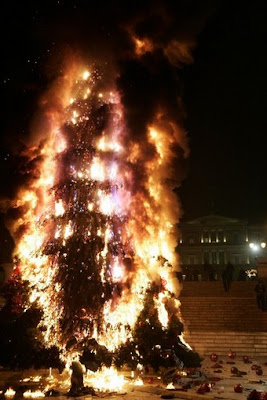
The exhilarating torching of the city's Christmas tree - a monument to our collective determination to celebrate Christmas and "have a good time" no matter what - was a poignant blow to the state's obession with monumentalizing itself: many enjoyed the symbolism of the event, many were shocked by what they saw as unecessary cruelty.

The displaying of a banner calling for "resistance" up on the Acropolis, an act of protest with a recent more famous precedent, was castigated as "blasphemous" by the usual champions of public order and good taste overall, and the vandalism of public buildings and statues was mourned by most of us - if only when one considers the hefty restoration costs.

What I found most interesting, however, was that at the time when angry protesters destroyed public monuments - erected in honour of events and institutions that they felt had nothing to do with them - or appropriated others (the Acropolis) in the hope that their voice might be heard, NEW monuments were in the process of being erected in Athens; and no, I don't mean the new Christmas tree hastily erected by our defiant mayor...

A new public monument emerged on the fateful crossroads where young Alexis lost his life, shot by a policeman who, apparently, "had had enough with those spoilt brats who'd better stay home". One by one, or in unison, people of most ages and backgrounds came to the site of Alexis's death in order to bring flowers, to light candles, or to display letters dedicated to his memory.

While municipal services were busy elsewhere, and riot police was entrusted with the protection of the city's site of festivities, some other Athenians re-named, albeit unoficially, the street where the boy was killed. Although it started as a pre-modern declaration of veneration, the monument produced is thoroughly modern. Little by little, the site became a "site", with a clear outline, visitors, snap-shot takers (incuding myself, of course) while unseen curators covered the exhibited notes in plastic to preserve them for posterity.

Even though the recent sad events appear as a break with the past, some, at least, of their protagonists assume roles so familiar to us from this very past they try to denounce. Monumentalizing collective ideology, often prone to emotive declarations of belonging, is a feature typical of the "modern man" (and woman). A monument to its past (recent or ancient) symbolizes an imagined community's reason of being and embodies its history, or rather the historical necessity of its existence. Paying one's respects to Alexis's monument (or rather to the monument of the site of his death, an event that led to the riots that are in fact monumentalized here) is a way of expressing allegiance to the (presumed) common cause.

So, brothers, do not despair. The Museum, one of modernity's central pillars, is alive and well. Yes, some museums might perish here and there; yes, some sites might get to know the "wrong kind" of appropriation; and, true, most of the rioters and sympathizers wouldn't be seen dead in a museum or a national heritage site (unless they carried a banner of protest). So what? As long as NEW monuments are created the good old way, not everything has been lost. Curators will always be needed and conservators will get new assignments.

In the meantime, the makeshift window-case in downtown Athens functions as a proper museum exhibit should: it creates a suitably sterilized artefact, an appropriately demarcated display, a virtual exhibit whose symbolisms amount to more than the sum of its parts. Sooner or later, a diligent hand is bound to add the necessary "Do Not Touch" sign.

18 Δεκ 2008

o christmas tree (2)

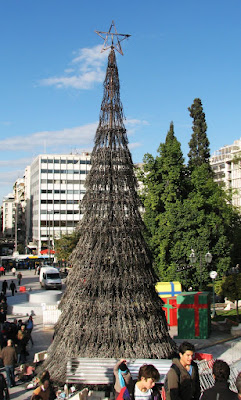
Last week, I was wondering whether the new christmas tree of Athens might be guarded against a potential attack. Owing to our mayor's determination, the city has acquired a new christmas decoration complete with twinkling lights and fake presents. And, lest some abominable creatures conspire against collective happiness, riot policemen were sent to guard the symbol of christmas:

Releaved by my worries about the fate of the city's festivities, I can only wish happy holidays to us all.


See you at Syndagma Square everybody!

9 Δεκ 2008

o christmas tree


This year, the Athenians decided to participate en masse in the decoration of their city for the holiday season. The new tree, for one, certainly looked more alternative than the tree of Christmas past - at least it was photographed and looked at a lot more than its predecessor.


So was the Christmas decoration, festive to be sure, albeit alluding - by a twist of absurdity - to what once was the county of Dalmatia (no, seriously, I'm not kidding!)


(and now a word from our sponsor:)


(A distressed mayor announced that order would be restored by the erection of a new tree, so that every Athenian would exercise their right to the festive twinkle of Christmas lights; as Athens was resuming its peaceful activities it remained unclear whether the new tree would be guarded 24/7 to prevent a renewed act of desecration). In the meantime, window shopping was seen under a thoroughly different light as well:


5 Δεκ 2008

Χτες, ξανά!

Το αίτημα για την αναπαράσταση της κλασικής αρχαιότητας για εκπαιδευτικούς, ψυχαγωγικούς ή άλλους σκοπούς αποτελεί πολλαπλή πρόκληση για τους επιστήμονες, ιστορικούς και αρχαιολόγους: πόσο καλά γνωρίζουμε το παρελθόν; Πόσο δεδομένη μπορεί να θεωρείται η επιστημονική γνώση του παρελθόντος; Πού τελειώνει η επιστημονική έρευνα και αρχίζει η ιστορική βεβαιότητα; Πότε πρέπει να ενημερώνεται το κοινό για τα πορίσματά μας; Μπορούμε να επιτρέψουμε στο ακροατήριό μας να κρίνει τα αποτελέσματα της εργασίας μας, αλλά και να επηρεάζει τα ερωτήματα που θέτουμε στην έρευνά μας;

[κείμενο με το οποίο συμμετείχα στην ημερίδα Αφήγηση Ιστοριών (storytelling) Σε Αρχαιολογικά Εικονικά Περιβάλλοντα που οργάνωσε το Ίδρυμα Μείζονος Ελληνισμού στις 25 Νοεμβρίου 2008.]

Το παρελθόν είναι μια σχετικά πρόσφατη επινόηση. Αν και οι ανθρώπινες κοινωνίες καλλιεργούσαν πάντα μία σχέση με το χρόνο, το παρελθόν ως ζώσα παρουσία εισήλθε στην καθημερινότητα των ανθρώπων στη Δύση μόλις με την αυγή της νεωτερικότητας.

Nicolas Poussin, Βοσκοί της Αρκαδίας (περ. 1640).

Είτε ως αποτέλεσμα «ανακάλυψης» – έρευνας, αποκάλυψης, ερμηνείας και οικειοποίησης – είτε ως αντικείμενο «αναβίωσης», επισκεπτόμαστε διαρκώς το παρελθόν (το μυθικό, το κλασικό, το ιστορικό ή ακόμη και το πρόσφατο, ήδη μυθοποιημένο) μέσω συνεχών αναπαραστάσεων που μας επιτρέπουν να το κατακτήσουμε.

Jean-Antoine Watteau, Αναχώρηση για τα Κύθηρα (1717).

Αν για τους νεωτερικούς Ευρωπαίους του 17ου αιώνα η επίσκεψη στο παρελθόν είχε τον χαρακτήρα αναπόλησης και στοχασμού για την ανθρώπινη κατάσταση, για τους απογόνους τους τον 18ο μετατράπηκε σε ταξίδι φυγής, προς μέρη εξωτικής γαλήνης. Πάντοτε όμως, το παρελθόν, ως «μια ξένη χώρα» (για να χρησιμοποιήσω κι εγώ την πασίγνωστη πλέον εναρκτήρια δήλωση του L.P. Hartley από τον Μεσάζοντα), νοείται ως τόπος, ως η χώρα της ουτοπικής εκπλήρωσης, η γη μιας επαγγελίας που αφορά πολύ περισσότερο το μέλλον και το παρόν από ότι το παρελθόν αυτό καθ’ εαυτό.

Αυτός ο ιδιότυπος τουρισμός προς το παρελθόν – εγγενές στοιχείο της νεωτερικότητας, καθώς εκφράζει την αυτοσυνειδησιακή ανάγκη του σύγχρονου δυτικού ανθρώπου – έχει πλέον εγκαταλείψει τις καλλιεργημένες ελίτ που τον επινόησαν τέσσερεις αιώνες πριν και έχει κατακτήσει – με θεαματικά αποτελέσματα – όλα σχεδόν τα στρώματα των σημερινών κοινωνιών, δυτικών και μη.

Σημαντικό ρόλο σε αυτή τη διεργασία έχει παίξει η διαβόητη πλέον στις μέρες μας πολιτιστική βιομηχανία η οποία έχει καταστήσει προσιτή στους πολλούς την πολιτισμική ψυχαγωγία των λίγων, όχι χωρίς κάποιο αντίτιμο όπως φοβούνται πολλοί, που κατηγορούν την παγκοσμιοποιημένη πολιτιστική βιομηχανία ότι κατασκευάζει φαινομενικές οντολογίες («πολιτισμικά αγαθά») τα οποία στη συνέχεια προωθεί προς μαζική κατανάλωση (μ’ ένα λόγο, ότι επιχειρεί την άνωθεν χειραγώγηση των καταναλωτών).

Η μαζική απόβαση στο παρελθόν που πραγματοποιείται στις μέρες μας, από ορδές ενθουσιωδών τουριστών σε θεματικά πάρκα της Μεγάλης Βρετανίας ή των Ηνωμένων Πολιτειών – όπως το διαβόητο Jorvik στο Αγγλικό York – δεν μπορεί παρά να ξενίσει τους περισσότερους από μας, ιστορικούς ή μη, που αναλογιζόμαστε με έκδηλη ενόχληση: «μα είναι αυτό ιστορία;»


Ήδη από τη δεκαετία του 1990, η άνθηση – για πολλούς στα όρια της κρυπτο-λατρείας – αυτού που ονομάζεται πλέον ευρέως «πολιτισμική κληρονομιά», με τελικό αποδέκτη το μαζικό κοινό και φορέα τους μηχανισμούς της πολιτιστικής βιομηχανίας, έχει δημιουργήσει μια ορατή και έντονη ρήξη με τον παλαιότερο, και καταξιωμένο ακαδημαϊκά θεσμό της ιστορίας, είτε ως επιστημονικής έρευνας είτε ως εκλαϊκευμένης επικοινωνίας με το πλατύ κοινό. Για τους μεν, η προσέγγιση του παρελθόντος ως «κληρονομιάς» εμπλέκει στη διαχείρισή του τον απλό άνθρωπο, τον οποίο κατά τα άλλα οι ακαδημαϊκές ενασχολήσεις των διανοουμένων αφήνουν παγερά αδιάφορο. Για τους δε (στους οποίους δεν περνά απαρατήρητος ο έλεγχος της «κληρονομιάς» από πολυεθνικούς παντοδύναμους οργανισμούς όπως η Εταιρία Disney) η προσωπική εμπλοκή με το παρελθόν ως «κληρονομιά» από-επιστημονικοποιεί την ιστορία, τη μυθοποιεί, την ακυρώνει.

Και σαν να μην έφταναν αυτά, έρχονται τώρα και χώροι παραδοσιακά συνδεδεμένοι με την ακαδημαϊκή μελέτη του παρελθόντος – κυρίως μουσεία, αλλά και σχολεία, αν όχι και πανεπιστήμια – που φλερτάρουν επικίνδυνα με τη βίωση του ανακατασκευασμένου παρελθόντος ως πολιτισμικής, πρωτίστως, και μετέπειτα ως γνωσιακής εμπειρίας. Πώς πρέπει να απαντήσει ο ιστορικός σε αυτήν την πλημμυρίδα των αλλαγών στον παραδοσιακό τρόπο μελέτης του παρελθόντος;

Παρατηρώντας γύρω μου, θα έλεγα ότι συνήθως απαντά «με δυσπιστία», και αντιμετωπίζει τις εξελίξεις αυτές ως απειλή για τον θεωρητικό ιστό και την επιστημονική ακεραιότητα της ιστορίας και της αρχαιολογίας. Πολλοί μελετητές ήδη από την προηγούμενη δεκαετία, θρηνούν για την αξιοκατάκριτη πορεία των επιστημών του ανθρώπου από τη θετικιστική μεθοδολογία της αντικειμενικότητας στο ανυπόληπτο και ρηχό συνονθύλευμα συναισθηματισμού και νοσταλγίας για το παρελθόν.

Η μελέτη του παρελθόντος ως «κληρονομιάς» αποτελεί κόλαφο για τις θετικιστικές προδιαγραφές της επιστήμης μας και αναιρεί κάθε προσδοκία για διαφανείς – «αντικειμενικές» – απαντήσεις στα επιστημονικά ζητήματα που θέτουμε. Πολλοί προειδοποιούν για τους κινδύνους που εγκυμονεί για τον επιστήμονα η «δέσμευση στην πολυσημία και τη διαφοροποίηση» και η επιδίωξη «της ρευστότητας και του σχετικισμού»: τον καθιστούν υποχείριο των ισχυρών, αυτών που (αόρατα;) ελέγχουν τη νέα παγκόσμια τάξη (καθώς είπαμε ότι η πολιτιστική βιομηχανία συνδέεται άμεσα με την παγκοσμιοποίηση).


Οι σημερινοί ιστορικοί και αρχαιολόγοι έχουμε ανατραφεί επιστημονικά εντός της θερμοκοιτίδας του θετικισμού, μιας απροκάλυπτα κλειστής κοινωνίας διανοουμένων των οποίων η αποστολή αποκλείει εκ των προτέρων την όποια διάδραση με τον εκτός ερευνητικής κοινότητας πληθυσμό. Δυσφορούμε απέναντι στη διεκδίκηση της πολιτισμικής κληρονομιάς εκ μέρους των τοπικών ή άλλων εξω-ακαδημαϊκών κοινωνιών, καθώς ταυτίζουμε ανάλογες πολιτισμικές δράσεις με το ανερμάτιστο και το ρηχό («depthless pastiche» αποκαλεί, σε άρθρο του το 1999, τα προϊόντα μαζικής διαχείρισης της πολιτισμικής κληρονομιάς ο Βρετανός αρχαιολόγος Ian Hodder). Είναι σαφές ότι το διακύβευμα αυτής της διαπάλης δεν είναι άλλο από το μονοπώλιο της γνώσης, ο ιεραρχικός χαρακτήρας της διάδοσής της και ο ορισμός της εκπαιδευτικής διαδικασίας ως μονόδρομου – από «επάνω» προς τα «κάτω», αποκλειστικά δηλαδή από την έδρα προς το θρανίο (είτε αυτό βρίσκεται μέσα ή έξω από την αίθουσα).

Μήπως όμως αυτή η έξοδος του ιστορικού από το πανεπιστημιακό κάμπους ώστε να βρεθεί αντιμέτωπος με τις επιθυμίες και τις διαθέσεις του μη ειδικού κοινού αποτελεί μια νέα πρόκληση για εμάς, νόμιμη όσο και γόνιμη, σύμφωνη με τις επιταγές της επιστήμης μας; Πόσο απέχει πραγματικά η αναβίωση του παρελθόντος που επιχειρείται στο Jorvik από τις αναπαραστατικές διαδικασίες που επιτάσσει η ιστορία και η αρχαιολογία όπως διαμορφώθηκαν ως επιστημολογικά παραδείγματα τον 19ο αιώνα;


Σίγουρα, η νοσταλγία των διαρκώς αναδυομένων τοπικών ή μειονοτικών κοινοτήτων για ένα εύχρηστο και ελκυστικό παρελθόν ώριμο για κατανάλωση από την «μετα-νεωτερική» κοινωνία της εφήμερης αναζήτησης αποξενώνει τον «σοβαρό μελετητή» (πάνω, η αναβίωση των αγώνων της Νεμέας). Η νοσταλγία αυτή ευθύνεται για την έξαρση της αναζήτησης συλλογικών ταυτοτήτων, μέσω των εικονικών ή φυσικών αναπαραστάσεων του παρελθόντος, των θεματικών πάρκων, και των πάσης φύσεως αναβιώσεων ιστορικών γεγονότων. Αποτέλεσμα αυτών των παρεμβάσεων μοιάζει να είναι ο «κατακερματισμός» της ιστορικής αλήθειας και η ελαχιστοποίηση της σημασίας του παρελθόντος, το οποίο υφίσταται έτσι τη φθορά της επανάληψης, της παρερμηνείας και της εμπορευματοποίησης.

Όμως το ερώτημα παραμένει: μπορεί η αναπαράσταση και η υπό ελεγχόμενες συνθήκες ανα-«βίωση» του παρελθόντος να έχει παιδευτική αξία; Και ποιος ο επιστημονικός ρόλος του ιστορικού σε αυτή τη διαδικασία;

Αναφέρθηκα πιο πάνω στην πασίγνωστη φράση του Hartley, πως «το παρελθόν είναι μια ξένη χώρα». Συνήθως, βέβαια, ξεχνάμε να διαβάσουμε τη συνέχεια: «εκεί τα πράγματα γίνονται διαφορετικά». Το νόημα της φράσης του συγγραφέα, όπως άλλωστε διαφαίνεται και από την ευανάγνωστη μελαγχολία που διατρέχει τη νουβέλα του, είναι ότι η προσπάθεια αναβίωσης του παρελθόντος εμπεριέχει αγωνία και πόνο, όχι ανέμελη χαρά – είναι επίπονη εργασία, όχι διασκέδαση (και είμαι βέβαιος ότι οι εκατοντάδες συνεργάτες του Ιδρύματος Μείζονος Ελληνισμού που κοπιάζουν για να υλοποιήσουν παρόμοια έργα το γνωρίζουν πολύ καλά αυτό...).


Πώς «γίνονται», επομένως, τα πράγματα στο παρελθόν; Οι πρώτοι αναστηλωτές της ελληνικής αρχαιότητας, εμπνεόμενοι από το πνεύμα του ρομαντισμού, οραματίστηκαν «ιδανικές όψεις» της κλασικής Αθήνας, και στη συνέχεια τις αναβίωσαν εκτός Ελλάδος, σε πλαγιές λόφων και δρυμούς ιδιωτικών πάρκων.


Πρωταγωνιστές της «ελληνικής αναβίωσης» του 18ου και του 19ου αιώνα ήταν οι ίδιοι οι μελετητές της κλασικής αρχαιότητας, από τον αρχιτέκτονα του Εθνικού Μνημείου της Σκωτίας (πάνω) έως τους δημιουργούς των μεγάλων ιδιωτικών πάρκων των οποίων οι ιδιοκτήτες – και σήμερα οι επισκέπτες – επιχείρησαν το ταξίδι στο κλασικό παρελθόν μέσα από την αναβίωση της αισθητικής εμπειρίας, μιας εμπειρίας επινοημένης, φυσικά, κατασκευασμένης σύμφωνα με τις ανάγκες των χρηστών της.


Μέσα από τη φαντασιακή επιστροφή στο παρελθόν, μέσω ενός ειδικά διαμορφωμένου παρόντος, το υποκείμενο αυτής της εμπειρίας διδάσκεται – συγκινησιακά, βεβαίως, αλλά διδάσκεται – πώς να συμπεριφέρεται ως καλλιεργημένος αρχαιόφιλος, με εκλεπτυσμένες προτιμήσεις και αίσθηση του κλασικού. Το μήνυμα του μαθήματος δεν είναι, προφανώς, το παρελθόν στην πραγματολογική του εντέλεια, αλλά το νεωτερικό ήθος απέναντι στο παρελθόν, η στρατηγική της οικειοποίησής του, η μέθοδος για να μάθει κανείς πώς «γίνονται τα πράγματα εκεί».


Φτάνοντας στο στούντιο για την τηλεοπτική αναπαράσταση σκηνών από την αρχαιότητα – σκηνών επινοημένων από έναν σεναριογράφο, οπτικοποιημένων από έναν σχεδιαστή, οργανωμένων από ένα σκηνοθέτη, «ντυμένων» από μια ενδυματολόγο, σκηνών που πρόκειται να παρασταθούν από μια ομάδα ηθοποιών και άλλων καλλιτεχνών – ο ιστορικός συνειδητοποιεί ότι έχει λίγα πράγματα να κάνει.

Η εικόνα που έχουμε όλοι – όλοι – για την αρχαιότητα (από τα βιβλία και την τηλεόραση, το Χόλυγουντ και τις διαφημίσεις, την ελληνική αναβίωση του 18ου και τον ακαδημαϊκό νεοκλασικισμό του 19ου αιώνα, αλλά και την «νεοελληνική» ελληνική αναβίωση του 20ού αιώνα) υπερτερεί της αρχαιότητας των πανεπιστημιακών κάμπους (που κι αυτή υποκαθιστά, με απολυταρχική αυθεντικότητα, την αρχαιότητα που κάποτε υπήρξε αλλά είναι πλέον νεκρή και απρόσιτη).

Και είναι φυσικό: δεν κάνουμε ιστορία, κάνουμε τηλεόραση. Πολύ περισσότερο, κάνουμε εκπαιδευτική τηλεόραση, θα λέγαμε, ένα σύγχρονο εκπαιδευτικό πρόγραμμα για τις ανάγκες ενός κορυφαίου πολιτιστικού ιδρύματος της χώρας – που σημαίνει ότι υπακούμε στις ανάγκες των μουσειοπαιδαγωγών και γενικά της σχολικής – εκπαιδευτικής κοινότητας, ενδεχομένως κρατώντας τους το χέρι για σιγουριά (επιτρέποντας όμως, εν τέλει, στο ακροατήριό μας και το απαραίτητο εκείνο ψήγμα δημιουργικής φαντασίας που θα εμπνεύσει τις «αναβιώσεις» του μέλλοντος).


Οι πραγματολογικές λεπτομέρειες έχουν τη σημασία τους – άλλωστε πίσω μας έχουμε δύο σχεδόν αιώνες απροκάλυπτου, σχεδόν χυδαίου εμπειρισμού μασκαρεμένου ως επιστημονική ορθότητα – όχι όμως τόση σημασία όσο η ευρύτερη «εμπειρία» – όρος που βδελύσσεται κάθε καλός θετικιστής – της αναβίωσης του παρελθόντος.

Σίγουρα πρέπει να βεβαιωθούμε ότι η φαντασία των εμπλεκομένων δεν θα οδηγήσει σε τερατογονία. Όμως η παρουσία ενός «επιστημονικού συμβούλου» σε τέτοιες διαδικασίες αφήγησης έχει και έναν άλλο, υπόρρητο σκοπό:

Δεν γνωρίζω να πω εάν και πόσο η εμπειρία τέτοιων προϊόντων προάγει την εκπαιδευτική διαδικασία. Βασίζομαι στη γνώση και την πείρα των δασκάλων, των μουσειολόγων και των μουσειοπαιδαγωγών που αξιοποιούν επιτεύγματα της παγκόσμιας πολιτιστικής βιομηχανίας τα οποία αποσπούν από το χώρο της μαζικής ψυχαγωγίας για να τα εισαγάγουν στην εκπαίδευση.

Όταν «επισκέπτεται» τo κλασικό παρελθόν, η πολιτιστική βιομηχανία επιδεικνύει χαρακτηριστική προσκόλληση στο «γράμμα» της αρχαιότητας.

Θυμόμαστε όλοι την σχετικά πρόσφατη κινηματογραφική παραγωγή Alexander του Oliver Stone, της οποίας προβεβλημένος συντελεστής, ως επιστημονικός σύμβουλος, υπήρξε ο καθηγητής του Πανεπιστημίου της Οξφόρδης Robin Lane Fox. Αν και η προσοχή στην πραγματολογική λεπτομέρεια της αναβίωσης δεν απαλλάσσει παρόμοια προϊόντα από τον κίνδυνο ιδεολογικών και πολιτικών παρεκτροπών, η επίκληση του «επιστημονικού συμβούλου» τα καθιστά δυνάμει εκπαιδευτικά.

Ο ρόλος του ιστορικού στην αφήγηση ιστοριών είναι, εν τέλει, καθαρά συμβολικός. Συμβολίζει την παιδευτική αξία του παραγόμενου υλικού και διαφυλάσσει – ενδεχομένως – το γράμμα της επιστημονικής του ορθότητας. Παράλληλα, ο ίδιος συνειδητοποιεί ότι ως επιστήμονας δεν τίθεται εκτός της ερευνητικής διαδικασίας, δεν στέκεται εκτός του επιστημονικού προβλήματος το οποίο μελετά, αλλά αποτελεί μέρος του. Αργά ή γρήγορα, ο ίδιος ή τα παιδιά του για παράδειγμα, θα μετατραπούν σε καταναλωτές του ίδιου του προϊόντος στην παραγωγή του οποίου συμμετέχει. Ο ιστορικός δεν διδάσκει μόνο, συμμετέχει και, παραδόξως, διδάσκεται για τις επιπτώσεις που έχει η επιστημονική του παρέμβαση σε ομάδες κοινού που όμως δεν αποτελούν το «κοινό του».